“Why do you look like you’re half dead?”
That question, uttered in passing, marked the moment that changed Philomena Dooley’s life. Up until then, she had been a registered nurse, but debilitating blood clotting issues had wreaked havoc on her health. She had experienced two pulmonary embolisms. Taking blood thinners and pain medications, wrapped from toe to groin in compression bandages, she still limped around in great pain. She was only 24 years old.
The condition forced Philomena to leave her hospital work and try real estate. At a convention in Florida, the cheeky comment from a fellow conventioneer got her attention. She would probably have never spoken to the man again, but a snowstorm in New Jersey stranded her at the conference. So, over lunch the man explained himself. He knew someone who could heal her, someone who had helped many people recover their health. That person was Mary Burmeister.
Until her death in 2008, Mary Burmeister was the American force behind the ancient Japanese art, Jin Shin Jyutsu®. Part energy modality, part life philosophy, Mary furthered the practice and interpreted it for modern day people. Her name and her work are still revered today.
Jin Shin Jyutsu (JSJ) originated in India 2500 years ago, and then migrated to China, and finally to Japan where it had almost completely died out by 1900. There were few written works that explained the ancient knowledge of the body, but Japanese philosopher, Jiro Murai, discovered The Kojiki. The name means Japanese Record of Ancient Things, and it held the answers Master Murai sought. By interpreting and applying these writings, Murai recovered from his chronic illness. He spent the rest of his life writing about and teaching Jin Shin Jyutsu. One successful student was Mary. And Mary chose to teach Philomena.
Finding Mary
It was 1978. Philomena was sick of being sick. Armed with Mary’s name and some vague information about energy work, Philomena decided she had nothing to lose by giving it a try. “I had the best treatments the medical world could do for me at the time, and I still looked half dead.” Her husband at the time and father of her children was a doctor. “He thought I had lost my marbles,” she says.
Feeling rotten can be a powerful motivator. Philomena booked a ten-day recovery trip to Scottsdale, Arizona where Mary was based. She received two treatments, twice a day from Mary and one of her students, Patricia Meador.
“By day five, I felt a dramatic change. I went from barely able to move to feeling like I had been awakened.”
Philomena recalls that on her return trip to New Jersey, her cousin didn’t recognize her at the airport. “I thought she was playing a game with me, but she really didn’t know me.” The same thing happened at her next doctor appointment. None of the symptoms she had been struggling with for so long persisted.
“My doctor said, ‘Whatever you’re doing, keep it up!’”
That was the beginning of Philomena’s career as a JSJ practitioner and teacher. “I didn’t decide to do this. I never decided. She decided.” Philomena laughs about this sudden change of path that was handed to her like a gift. While she did sit for trainings, she says the experience of becoming a JSJ practitioner was more like remembering.
“I would get phone calls from Mary asking me to go out to Long Island to a hospital. ’I don’t know what to do,’ I’d say. ‘Of course you do,’” Mary would respond. And, it turns out, she really did.
Her connection to the healing art and to its American leader was remarkable. Philomena says Mary would pull her aside and start talking to her about healing … in Japanese. She laughs, “I don’t speak Japanese, but I understood what she meant, even without the words. It was like we were …” Philomena winds her first two fingers together to show their intertwined connection.
Philomena’s 36 years in Jin Shin Jyutsu have been characterized by divine providence. So often, the people she needed to meet would just appear and ask for help. Most importantly, Philomena would say yes when those gifts appeared. Can you go help this person? Yes. Do you want to help me teach this workshop? Yes. Accepting these gifts has provided Philomena with a life’s work full of meaning and opportunity.
She recalls the experience of helping Mary teach a series of workshops in New York in 1986. “A doctor from France came up to me and said, ‘This is wonderful. I don’t understand a word of it. Could you come to Paris to teach me?’” Philomena worked out a week to come help. “And that was the beginning of my international practice.”
She went twice a year to teach medics and medical professionals for the next couple of decades. She has since taught workshops on JSJ in Lebanon, Dubai, Singapore, Australia, New Zealand, Germany, France, Ireland, England, Scotland, and all over the U.S. and Canada.
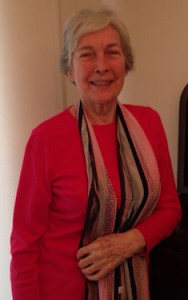
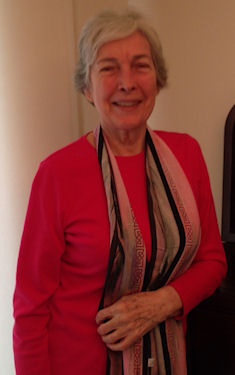
Now at age 80, Philomena appears to be closer to 60. Sitting in her Boulder, Colorado home-based treatment room, her hands repeatedly smooth the sheet of the treatment table in front of her. As she chases away the wrinkles, her fingers are powerful, her body confident. The pain of her youth is long gone, though the accent of her Ireland birth land still weaves through her crisp syllables. She says she has treated many, many people of all kinds – even Asian royalty.
“People come to me from all over the world,” she says. That experience has shown her that all people are exactly the same. “They all have the exact same blockages in the shoulders. People are just people,” she says.
But What Is JSJ or Jin Shin?
That question is one Philomena declines to answer in detail. Instead she invites the questioner to experience a treatment. “Would you like to lie down?” she offers.
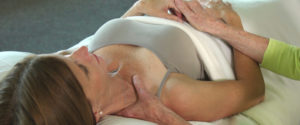
She gifted me a treatment as a part of this interview process. The actual procedure involves holding various energy locks on the body. With her hands on my torso, feet, back, thighs, head or hands, she would seek harmony in the vibrations of my body’s energy system. It felt deeply relaxing, like warm liquid dripping slowly down my skin. The pain in my feet that I didn’t tell her about resolved during the session. Referring to a term coined by Mary, Philomena says the ‘jumper cables’ (her hands) encourage the body to right its own wrongs and unblock jams of energy that should flow freely, but often don’t.
“It’s a modern problem to have all the energy stuck in the back, shoulders, and neck,” she says. “We are so uptight. And what does that do? We’re living in this oval of energy. It flows down the front and up the back. Energy descends the front and ascends the back. It’s almost like living in an egg. Down the front and up the back.”
She explains that what we often call problems we should refer to as projects. “When we have a project that is above the waist, usually the cause is below the waist. As it is above, so it is below. As it is on the back, so it is on the front. And the same on the left and right. That’s the basic principal.”
In part because she can ‘speak doctor’ and partly because she shows instead of tells, Philomena has inspired doctors and hospital administrators to invite JSJ practitioners to volunteer in their facilities. Philomena started her first hospital JSJ project 30 years ago at Morristown Memorial Hospital, in Morristown New Jersey. Her volunteers have been offering treatments on every floor of the hospital, speeding patients to recovery much faster than the norm. Most recently she has helped begin a trial of JSJ for drug addicted newborns at the a hospital NICU in Lexington, Kentucky. She says that treatments reduce the detox and recovery time from 28 days to nine or ten. It will begin officially in January.
Trying to be retired now, Philomena plans to teach one more upper level JSJ course in Spain next September. But knowing how many little projects she is involved in, it’s hard to imagine that life will really slow down any time soon.
Philomena credits all of these opportunities directly to Mary. She says she is grateful and a little mystified at all that has happened. As we finish speaking, she leaves me with this quote from Mary,
“The truth is that within each one of us lies the power to cast all misery aside and to know complete peace and oneness. To be that beautiful creature of perfect harmony. To truly know (help) myself.” ~ Mary Burmeister.
Philomena couldn’t agree more.
Corey Radman is is an award-winning writer based in Fort Collins, Colorado. Her passion for story threads its way through her work, which has been published at 5280 Magazine, Style Magazine, Northern Colorado Medical & Wellness, Get Born Magazine, and The Mom Egg. Her monthly spotlights at Whisperingtree.net feature interviews with experts in integrative healing who constantly challenge her ideas of ‘the best way to be.’
She can be contacted via her website at www.fortcollinswriter.com.
![[Home]](http://www.feelintegrated.com/images/logo.gif)

![[Massage]](http://www.feelintegrated.com/images/massage_up_01.gif)
![[Jin Shin Jyutsu]](http://www.feelintegrated.com/images/jsj_up_01.gif)
![[CFT]](http://www.feelintegrated.com/images/cft_up_01.gif)
![[Feedback]](http://www.feelintegrated.com/images/feedback_up_01.gif)
![[Contact/About]](http://www.feelintegrated.com/images/about_contact_up_01.gif)
![[Resources]](http://www.feelintegrated.com/images/resources_down_01.gif)
![[Massage]](http://www.feelintegrated.com/images/massage_02.gif)
![[Jin Shin Jyutsu]](http://www.feelintegrated.com/images/jsj_02.gif)

![[Feedback]](http://www.feelintegrated.com/images/feedback_02.gif)
![[Contact]](http://www.feelintegrated.com/images/about_contact_02.gif)
![[Resources]](http://www.feelintegrated.com/images/resources_dock.gif)



 One of the hospitals in the US with a Jin Shin Jyutsu® program is found at the University of Kentucky. This article was written by Jennifer Bradley, who is a Jin Shin Jyutsu® practitioner at UK HealthCare.

 For those of you who are looking to learn more about Jin Shin Jyutsu and its application in modern/Western medicine, I highly recommend this article entitled



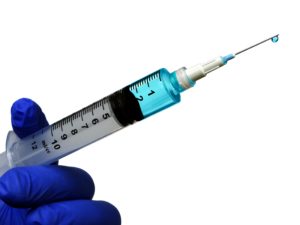 It’s Winter, time to get your flu shot, right? Not so fast.